Find out if it’s worth pursuing.
Bring the idea and whatever you know. Plangate investigates the market, demand, competition, costs, risks and economics without pretending every answer is known yet.
Validate My Idea →Before you spend your savings, quit your job, rent a space, buy equipment, or spend months building — let Plangate find out what can actually work.
Already have an idea? We’ll investigate it.
No idea yet? We’ll find opportunities matched to your location, goals, skills and resources.
Find it. Prove it. Build it.
No perfect budget required. No business plan required. Start with what you know.
Plangate adapts the investigation to the business — from local services, retail and manufacturing to ecommerce, online businesses, SaaS and AI.
Bring the idea and whatever you know. Plangate investigates the market, demand, competition, costs, risks and economics without pretending every answer is known yet.
Validate My Idea →Start with your location, goals, interests, skills, resources and constraints. “I don’t know yet” remains a valid answer while Plangate does the research.
Find My Business →The research path adapts to the idea. A local manufacturer needs different evidence from a SaaS product, and incomplete context does not stop the investigation from starting.
“I’m considering a small custom-label manufacturing business.”
✓ One sentence is enough to start.
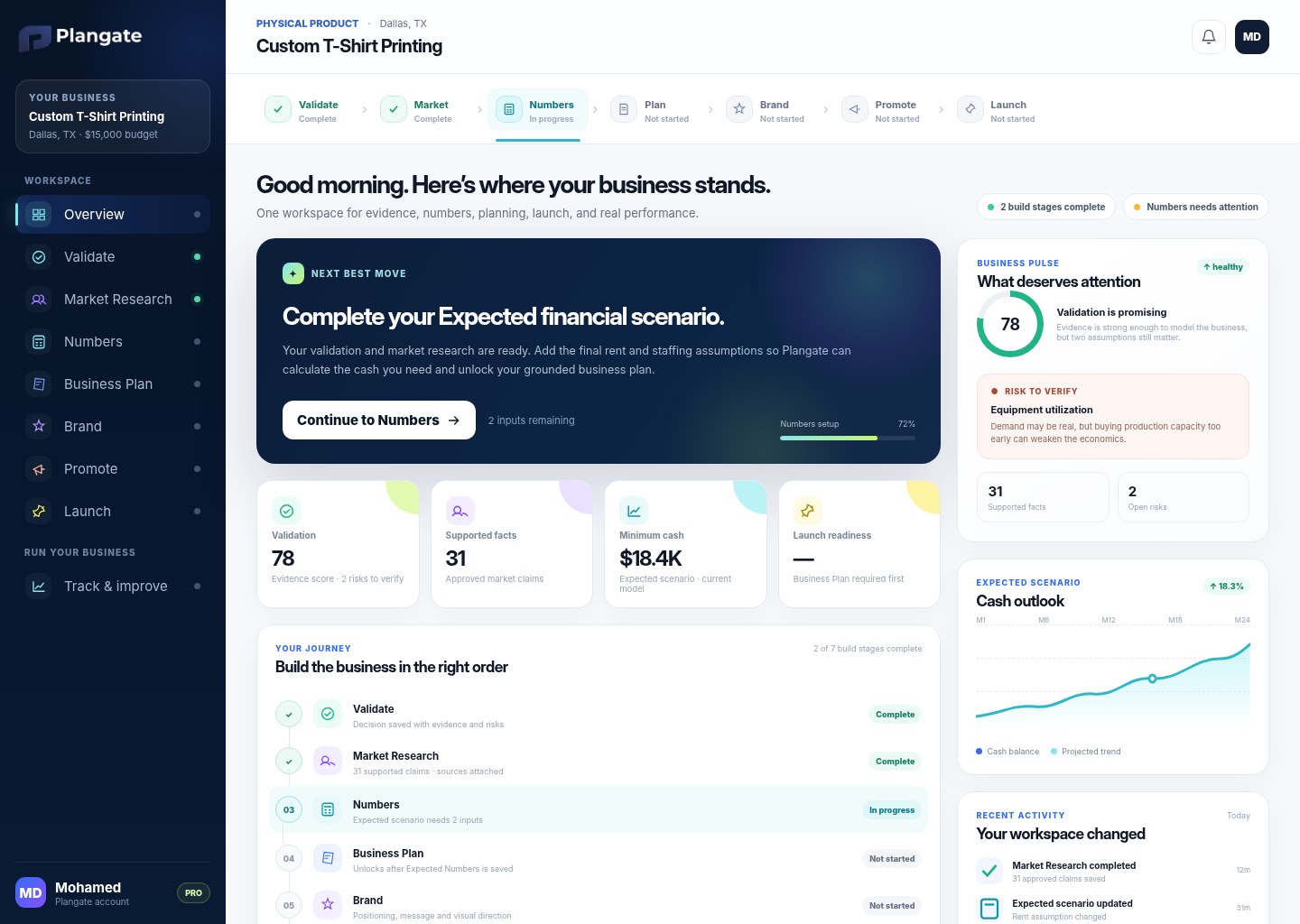
External evidence and founder-controlled assumptions stay separate, visible and traceable. This completed sample shows the shape of proof—not a live research result.
Plangate turns a rough idea into a focused investigation without treating missing details as facts.
“Custom-label manufacturing for growing local brands.”
A good decision system should not ask a mobile service, a factory and an AI product the same generic questions. Plangate changes the research around how the business actually works.
Geography shapes the answer. Plangate focuses on where demand sits, how far the operator can travel, and whether price covers time and labor.
The investigation follows the production constraint: what must be bought, how much it can make, and what volume pays for the setup.
Digital businesses trade location constraints for distribution pressure. Plangate examines the offer, acquisition path and whether the economics can scale.
Move from validation to market research, economics, planning, launch, and actual performance without starting over in another tool.

Verdict, reasons, risks, sources, and the next move — all attached to the same business.
Selling price, volume, margin, rent, staff, and startup costs feed a deterministic financial model — not invented AI arithmetic.
Move the assumptions and see the economics respond immediately.
Find the opportunity, prove it, understand the market, make the numbers work, build the plan, prepare the brand and promotion, launch, then compare the plan with reality.
Evidence informs assumptions. Assumptions inform the plan. The plan becomes launch work. Actual results tell Founder what deserves attention next.
You're not buying a report. You're pressure-testing a decision before equipment, rent, inventory, hiring, or marketing spend starts leaving your account.
Move the slider. The comparison does not claim guaranteed savings — it simply shows how small the decision-checking cost is relative to the amount you may be about to commit.
Buying capacity before demand is proven can lock cash into an asset you don't fully use.
Pressure-test utilization first.Deposits, fit-out, and months of rent can compound quickly if the location assumptions are wrong.
Check demand and economics first.A business can be busy and still lose money if price, materials, labor, and overhead don't leave enough margin.
Model break-even before launch.Optimistic volume can make almost any spreadsheet look good. Plangate keeps assumptions explicit.
Use Conservative / Expected / Strong.Business ideas, opportunities, free tools, guides, examples, and research all feed into the same validation journey.
Browse businesses by budget, type, equipment, and what the operator actually needs to get started.
Explore business ideas →
Startup cost, break-even, margin, funding need, and idea generation.
Use free tools →Decision guides and workbooks built around real business choices.
Browse guides →Manufacturing, machines, startup economics, and validation topics.
Read insights →
Preview how evidence, Numbers, plans, and launch work fit together.
See product →Practical books, workbooks, scorecards, and calculators for people who want to think through the business away from the app too.
Real startup-cost logic, example economics, fit profiles, a seven-day test workbook, and an idea-finder spreadsheet — not another list of vague side hustles.
See the book →

25 evidence-based ideas matched to your budget, skills, time, and income goals.
Explore the guide →
Test the location, economics, agreement, and seven-day validation path before buying the machine.
See the workbook →Search-led guides help founders understand machines, business models, startup costs, customers, and what to validate before investing.

Realistic products, equipment, buyers, risks, and what to validate before you invest.
Read the guide →
How to evaluate the machine, product demand, capacity, and payback together.
Explore →
Demand, customer acquisition, utilization, price, and local constraints.
Learn more →Start free. When a business earns deeper work, choose the outcome you need first; the credit allowance and action costs remain visible underneath.
Plangate costs $19–$89 to pressure-test that decision before the larger commitment.
Paid AI actions require a settled credit-pack purchase or an active Founder entitlement.
Get the evidence, risks and economics needed to decide whether to proceed, change the model or stop.
Move from verdict and market evidence through Numbers, planning, brand, promotion and launch preparation.
Research several directions, pressure-test the finalists and keep enough room to prepare the winner for launch.
Founder keeps the business context and decisions already saved, compares the plan with what actually happened, surfaces material risks, and helps identify the next useful move.
Budget, validation decisions, research, assumptions, launch tasks, goals, experiments and actual performance remain part of the same operating context.
Actual revenue is 8% below plan, but gross margin is holding. Test the offer before adding more traffic.
Start with an idea or start without one. Plangate helps you find the opportunity, prove the decision and carry the same business forward.